Loading Data
Please wait a moment...
Update Cal.
2026.08
03
Mon
04
Tue
05
Wed
06
Thu
07
Fri
08
Sat
09
Sun
Update Calendar
2026.08
01
Sat
02
Sun
03
Mon
04
Tue
05
Wed
06
Thu
07
Fri
08
Sat
09
Sun
10
Mon
11
Tue
12
Wed
13
Thu
14
Fri

Loading Data
Please wait a moment...
Morning features and interviews. A morning story over a cup.
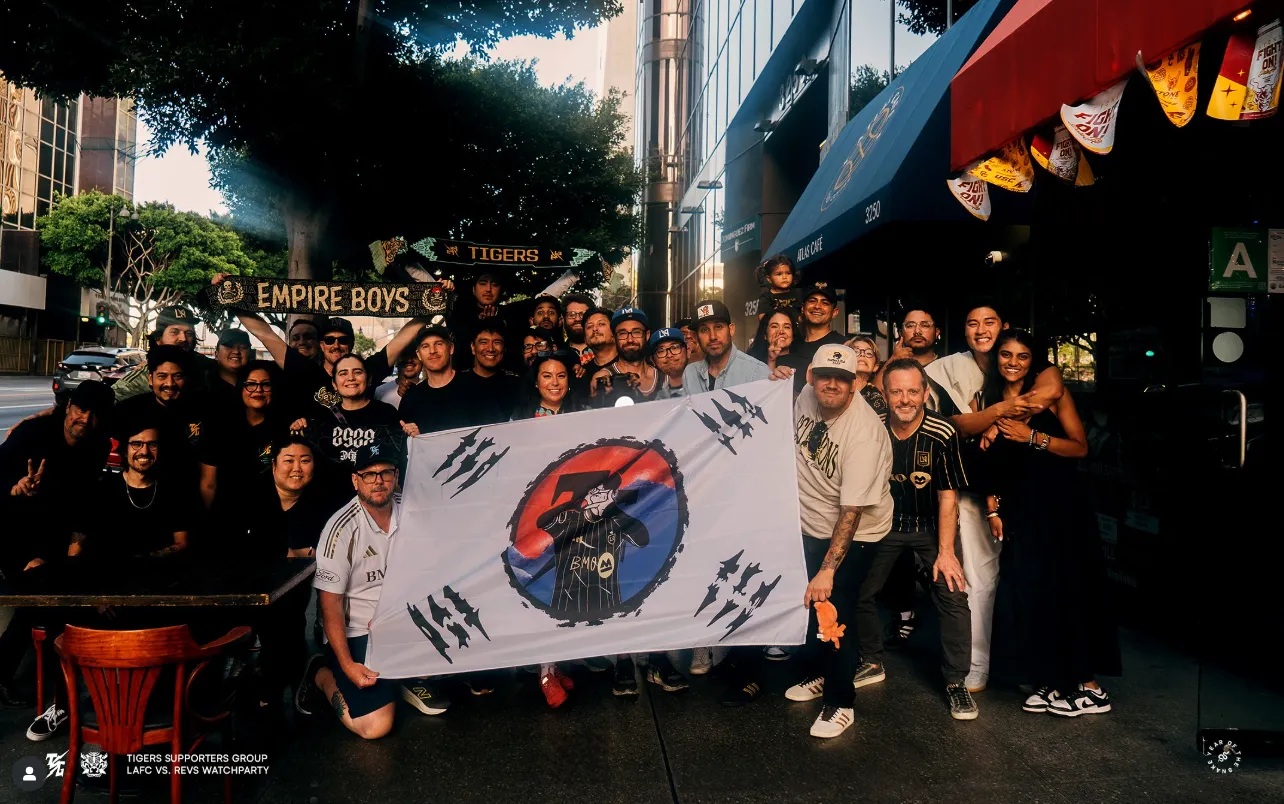
The ownership group of LAFC, Son Heung-min's new team, is stacked with famous figures such as NBA legend Magic Johnson and US women's soccer legend Mia Hamm. What the LAFC ownership group, made up of 26 people in total, has in common is that they are figures who have created boundary-breaking innovation in their respective fields.[The achievements of LA84's activities © LA84 Foundation]Magic Johnson, after publicly disclosing his HIV infection in 1991, led social change by fighting prejudice against the disease, and Mia Hamm proved the possibility of women's sports to the whole world. Along with this ownership group, a phrase that stands out when you access the LAFC Foundation website also reveals LAFC's character. The phrase "We are a proud member of the LA84 Alliance, a joint diversity, equity, and inclusion (DEI) initiative of 11 LA-area professional teams in partnership with LA84" introduces the goal of the LA84 Alliance, which goes beyond a mere alliance of sports teams. The LA84 Alliance — a cooperative body jointly pursued by 11 LA-area professional teams, from the LA Dodgers, Lakers, Clippers, Rams, Chargers, Kings, Ducks, Angel City FC, Sparks, to LAFC — is moving for social change across the entire city. The core of this program is to expand each team's individual efforts into city-level synergy. At the "Alliance Unity March," held in July 2021 to mark the first anniversary of George Floyd's death, LAFC Vice President Benny Tran even gave a speech in person.[Notice of the 2025 Women's Empowerment Night © LAFC]Women's Empowerment Night: Practice Beyond a SloganOn March 1 this year, LAFC partnered with Cinnamon Toast Crunch to hold a "Women's Empowerment Night." This event, attended by high-school girls, was not a mere marketing event but an occasion to publicize a platform for developing women's leadership and expanding opportunities. At the event, a panel talk by LAFC's female staff was held. Mia Hamm participating as an owner also takes on meaning seen in this context. Mia Hamm is not a mere investor but a partner who draws up, together, LAFC's long-term vision for the development of women's sports. What is interesting is that after Son Heung-min's joining, Asian women's interest in soccer has sharply risen. At BMO Stadium, you can now easily find female fans conversing in Korean, Japanese, and Chinese. It is a diversity-spreading effect created by a single global star.LA County is the region with the largest Asian population in the United States. About 1.5 million Asians live there, a figure reaching about 15% of the total population. But apart from the baseball player Shohei Ohtani, a star representing Asians has not been prominent in mainstream sports. Son Heung-min's appearance is a symbolic event that fills this gap. The figure of the highest transfer fee in the history of the US professional soccer league MLS makes this symbolism felt even more greatly. It can also be seen as meaning that LAFC views the Asian market not as a mere "niche" but as the "mainstream."There was an effect. In fact, at Son Heung-min's debut match against Chicago Fire on August 10, 22,000 seats sold out. Fans wearing Korea, Tottenham, and Bayer Leverkusen jerseys were spotted throughout the stadium, and some fans even shed tears of emotion at this historic moment.Diversity Gathered by the Common Denominator of SoccerThe name of the LAFC supporters' group "3252" is taken from the capacity of the supporters' section at the north end of BMO Stadium. The cheering songs they sing are sung in three languages: English, Spanish, and Korean. This multilingual cheering culture began with the Koreatown-based "Tigers Supporter Group (TSG)." Founded in 2017 with 15 members, this group has now grown to more than 100 and is one of 3252's major fan groups. LAFC's strategy is to integrate diversity rather than divide it. While respecting each community's unique culture, it binds them into one identity through the common denominator of soccer.[The Tigers Supporter Group © lafc_tsg]The new scenes witnessed at BMO Stadium prove this: the fusion of Korean traditional cheering culture and Mexican-American cheering culture, cheering banners made in various Asian languages, and the increase in Asian family-unit spectators across generations. The lesson LAFC's diversity strategy gives to companies is clear: diversity is not a mere slogan but a core driver of business success. In particular, our companies competing in the global market cannot help but consider such an inclusive approach. For companies aiming to advance overseas, LAFC's case provides a practical benchmarking point.The Future of the Partnership Son Heung-min and LAFC Will CompleteOn the occasion of Son Heung-min's entry into LAFC, ESG.ONL examined the meaning of this new encounter. Part 1 illuminated community-based trust, Part 2 the social-contribution system, Part 3 sustainable eco-friendly infrastructure, and the final Part 4 the philosophy of diversity and inclusion, the foundation for the preceding elements to work in harmony.The true values of LAFC discovered through Son Heung-min were: the symbolism of an Asia-based global star and the opportunity to connect to global impact, natural communication and exchange with various cultures, the alignment of a personal brand and organizational values, and a practical platform for social change through soccer. It is worth expecting that LAFC will open up the possibility of providing Son Heung-min not simply a place to play soccer but a stage that changes the world.by Editor L

Now that we have entered the latter half of 2025, at this point when the earnings reports of major companies are wrapping up, there is a report that must be examined as importantly as the earnings — the "sustainability management report," which checks a company's ESG moves. Because a sustainability management report lets one confirm a company's goals, moves, and outlook for ESG management, it plays the role of an important evaluation indicator, all the more as corporate environmental and social responsibility comes to the fore. Today, we review the "2024 Amorepacific Holdings Sustainability Report" of "Amorepacific," the leading player in Korea's beauty industry.2030 A MORE Beautiful Promise[Cover of the 2024 Amorepacific Holdings Sustainability Report © Amorepacific]The influence of K-beauty is formidable. According to the Ministry of Food and Drug Safety, Korea's cosmetics exports in the first half amounted to 5.5 billion dollars (about 7.6026 trillion won), a record high. Actively entering not only the traditional export market of China but also the Middle East and South America, it proved that K-beauty's achievements are not a temporary phenomenon appearing only in a particular region. At the center of such K-beauty, how is Amorepacific (hereafter "Amore"), active under the calling of "making people beautiful, making the world beautiful," striving to make the world beautiful?Amore is executing a strategy of fulfilling five promises based on the two axes of "walking together with customers and society" and "coexistence with great nature." Specifically, to contribute to realizing customers' sustainable lifestyles, it reduces the carbon footprint of all new products through Life Cycle Assessment (LCA) and actively uses renewable energy. It reduces the environmental impact of cosmetics packaging by improving the materials of plastic packaging, and to minimize the environmental impact of the palm-oil cultivation process — palm oil being used as a raw material across beauty products — it is also making the effort to fully use palm oil certified by the "Roundtable on Sustainable Palm Oil (RSPO)." Beyond this, spreading the values of diversity and inclusion, Amore pursues sustainability toward the environment and society as a whole.Sustainability in the Cosmetics Development and Manufacturing ProcessThe product Life Cycle Assessment that Amore established comprehensively analyzes the environmental impacts arising throughout a product's entire process — raw-material extraction, production, distribution, use, and disposal. This assessment consists of 16 categories containing factors that can affect the environment and humans, such as fossil fuels, water use, acidification, toxic components, and fine-dust formation. Therefore, the Life Cycle Assessment can be used as an objective indicator to refer to when developing new products, as a standard by which consumers purchase products, and through this it can also draw out positive change across the industry.[Dongbuk-Bukchon Wind Farm © Renewable Energy Guide]In addition, in 2024, Amore achieved RE100 by converting 100% of the electricity used at its four major production sites and logistics centers nationwide to renewable energy. Amore sought the renewable-energy transition by directly building solar-power systems on idle land at its sites and logistics centers, and mobilizing various methods such as direct and third-party Power Purchase Agreements (PPA), Virtual Power Purchase Agreements (VPPA), the purchase of Renewable Energy Certificates (REC), and green tariff plans. Among these, the VPPA is a power-purchase-agreement format that Amore concluded for the first time in Korea. With this, Amore became a company that applied the maximum methodologies for securing renewable energy available in Korea.The Company's Efforts for Value ConsumptionAmore conducts a materiality assessment to identify, among the ESG matters related to its business, those that must be dealt with first. The materiality matter ranked first in the 2024 report is the environmental impact of packaging. This is based on the judgment that, through packaging improvement, it can reduce carbon emissions and improve the recycling rate, giving a real positive impact to the environment. Considering that most cosmetics use plastic packaging, building a plastic-circulation model based on the 4R strategy — reducing plastic packaging use (Reduce), raising recyclability (Recycle), creating an environment for reuse (Reuse), and directly recovering containers (Return) — will hold great meaning.In fact, Amore reduced plastic use by 1,696 tons over the single year of 2024 through the expanded application of recycled plastic and the lightening of packaging. It also succeeded in cutting about 4.2 tons of plastic use by improving cap designs and removing unnecessary spatula specifications. Amore plans to reduce plastic use by continuously applying such improvements.[Cosmetics that adopted refill capsules © Amorepacific]There are also cases of making recycling easy by not mixing materials other than plastic into cosmetics packaging. It improved product specifications so that containers could be recycled without a complex process — by removing the steel spring inside a pump, or replacing the cap material from steel with the same plastic material as the container. Alternatively, by selling refill containers separately and encouraging repeated use of the case, it reduced plastic use by 81% compared with buying a new product, and by directly intervening in resource circulation through an empty-bottle collection campaign, it collected a cumulative 2,721 tons of empty bottles.Such a resource-circulation model holds significance in that it enables value consumption — that simply buying Amore's products adds to ESG. What Amore protects is, beyond simply the Earth and the environment, the sustainability of K-beauty, which has become a culture in itself. If you are curious what the beautiful world Amore envisions looks like, how about confirming it through the sustainability report?by Editor L
"J.P. Morgan Chase" (hereafter "JPMorgan"), the largest bank in the United States, announced a carbon-credit tokenization project. This innovative project, announced on July 2, is an ambitious attempt to solve the fundamental problems of the existing carbon market with blockchain technology. Tokenization refers to the technology of converting physical carbon credits into digital tokens on a blockchain. Each token represents the removal or prevention of one ton of carbon dioxide, and it guarantees perfect traceability based on the immutability and transparency of the blockchain. JPMorgan's solution directly tokenizes carbon credits registered in registry systems, making it possible to track the entire life cycle in real time, from issuance to retirement. Through this, it can remove the risk of double counting — in which a single carbon credit is simultaneously recognized or traded in different trading systems — in the carbon trading market, and build a consistent tokenized carbon ecosystem between sellers and buyers.[JPMorgan Chase © JPMorgan]A Technical Approach to Solving the Market's ProblemsJPMorgan's private blockchain network "Kinexys" concluded partnerships with three major carbon registries — S&P Global Commodity Insights, EcoRegistry, and the International Carbon Registry (ICR). The core is developing an application that converts carbon credits registered in the registry systems these institutions manage into blockchain tokens.EcoRegistry and the International Carbon Registry have each already successfully completed testing of their respective solutions. S&P Global Commodity Insights begins its test through "Environmental Registry," a customized registry-service platform for whole-life-cycle tracking and improved management of carbon credits. Going forward, a meta registry — a system that integrates and manages multiple carbon registries — is also to be included in the testing.This pilot program focuses on managing accounts, projects, and the credit life cycle — that is, the process from the creation to the recovery of credits. The goal is to test technical connectivity, data-model compatibility, and overall functionality so that external stakeholders can more easily read and use registry data. This is also a measure to solve various problems in the current carbon-credit market. Problems that have long created concern about carbon trading are becoming a threat to the credibility of the credit market as well. The tracking of carbon credits from issuance to retirement is still assessed as opaque. Concerns about greenwashing also persist.Alastair Northway, head of natural-resources advisory at JPMorgan Payments, emphasized, "The voluntary carbon market is in desperate need of innovation. Tokenization can support the development of a globally interoperable system that will improve trust in the underlying infrastructure. With this technology, greater information and price transparency can be secured, and ultimately market liquidity can be increased."[The Kinexys logo © Kinexys by J.P. Morgan]The Rapidly Growing Carbon Trading Market, an Investment OpportunityJPMorgan's carbon-credit tokenization is part of its digital-asset strategy. Kinexys, in operation since 2015, has established itself as a global leader in the field of moving funds, assets, and information through blockchain-based infrastructure. This past May, it succeeded in cross-settlement between private and public blockchains, and it is actively pursuing the integration of the existing financial system and blockchain — such as recognizing shares of BlackRock's US bitcoin spot ETF (IBIT) as loan collateral. In June, it also applied for a trademark for "JPM Coin (JPMD)," a digital deposit token backed 1:1 in US-dollar value on the crypto-based Base network. In addition, JPMorgan is strengthening its role in the carbon market — for instance, contracting with the Canadian carbon-capture company "CO280" for 450,000 tons of carbon-removal services over 13 years at a price of less than 200 dollars per ton.As of 2025, the global carbon-credit market is valued at 933.2 billion dollars, and its value is expected to grow to the level of trillions of dollars by 2030. The demand for carbon-offset purchases by major companies facing their 2030 carbon-neutrality targets is also projected to surge. A carbon offset means pursuing activities that reduce carbon emissions in order to offset or reduce carbon emissions. Carbon-offset prices are currently formed in a wide range from 1 dollar to 100 dollars per ton, and their value is determined by the type and efficiency of the pollution-prevention activity. Over the next few years, offset purchases by companies to meet their carbon-emission quotas are expected to increase greatly.[EcoRegistry, which announced its participation in the project © EcoRegistry]The Partners' Roles, and Expected EffectsJonty Rushforth, head of product and portfolio for the energy-transition division at S&P Global Commodity Insights, expressed the expectation, "We are glad that JPMorgan's Kinexys has recognized the value and mission of 'Environmental Registry,' and if this collaborative test proceeds as expected and eventually includes the meta registry, we will be able to expand the Environmental Registry infrastructure solution into the financial industry and create an innovative expansion of the carbon market."Juan Durán, CEO of EcoRegistry, also explained a positive outlook: "The carbon market is continuously evolving, connecting core elements to strengthen trust and transparency across the ecosystem. Integration with Kinexys digital assets is an important step in expanding the role of the financial sector in this field."This project foreshadows a paradigm shift in environmental finance beyond a mere technical experiment. If successful, it could become the foundation of an international verification standard, building a more robust cooperation system among the market, registries, and regulators. As the use of blockchain technology spreads in the global climate-finance market, let us watch whether a new environmental-finance ecosystem that can secure transparency and efficiency at the same time will be built.by Editor L
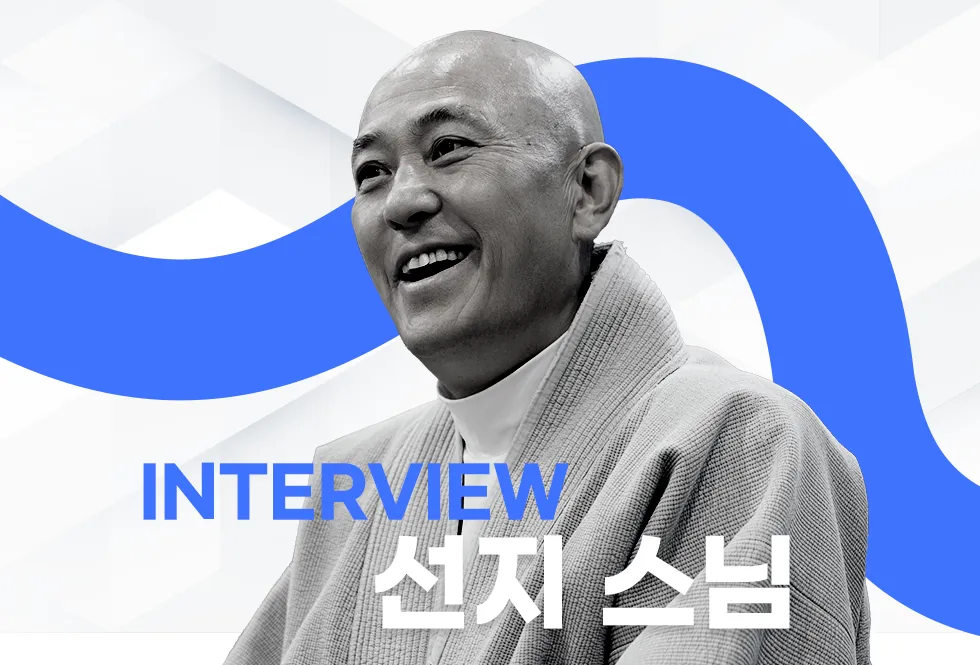
How can ESG management be interpreted from a religious perspective? Buddhism has long valued the concept of "symbiosis (coexistence)." To learn what the future of a sustainable world looks like through the eyes of the Buddhist community, we met Ven. Seonji, author of "Buddha Management," which conveys "symbiotic ESG management," and heard the wisdom of ESG management needed in this era.At the threshold of spring, I headed to Mapo to meet Ven. Seonji, author of "Buddha Management" and abbot of Jungnimsa Temple in Yeongcheon. Much interest has concentrated on this book, which views ESG through the eyes of religion. We arranged to meet the Venerable — who had come up to Seoul for a broadcast appearance — at a coffee shop near the broadcasting station. The editor, arriving an hour earlier than the interview time, spotted from afar the Venerable absorbed with a pen in hand in one corner of the café. Worried that an early visit might disturb him, I carefully slipped away.At the café I visited again at the appointed time, the Venerable welcomed ESG.ONL with a bright, childlike smile. From the Venerable's appearance, the spirit of a pure and frugal ascetic could be felt. His clean but frayed-fronted quilted jacket seemed to represent the Venerable's simple life, stirring in the heart of this worldly person, worn out living in the city, a ripple as clear as the sound of a dawn temple bell. How did the Venerable meet ESG and weave that thought into a book?["Buddha Management," which explains "sustainable symbiotic ESG" © ESG.ONL]The Meeting of Buddhism and ESG ManagementVen. Seonji began to think he should view ESG from a Buddhist perspective while preparing for his doctoral degree at Dongguk University. Existing works of Buddhist studies include various books by scholarly monks in academia. Ven. Seonji thought, "Do I really need to major in that field too?" There was another point of concern. The Venerable pondered whether there might be a way to apply the Buddha's teachings to modern society and convey them easily. Thus the Venerable met ESG. At first, he sought to shed light on the changing state of temple environments and surrounding ecosystems.The global trend emphasizing the themes of ESG management — environment, society, transparent governance — is spreading into the political, social, and cultural spheres. Thinking, "Can Buddhism alone be free within this social current?", Ven. Seonji put into this book the wish that the Buddhist community should at least know what ESG is and take an interest in why it should be practiced. He wrote it feeling the awareness that today's sangha, having inherited a brilliant culture, must preserve the ground we must live on together with future generations.The Modern Practice of the "Bodhisattva Way": Symbiotic ESG ManagementWhen it comes to Buddhism, many people will first think of Ven. Beopjeong's "Non-Possession." Starting one's thinking this way, the link between ESG and Buddhism does not readily come to mind. In fact, non-possession applies to ascetics; it was not saying that ordinary sentient beings too should practice non-possession. There were many merchants and industrialists near the Buddha. They came seeking the Buddha's teachings. Ven. Seonji said that what the Buddha told them at that time was "do not possess more than what you have."Viewing the world according to the principle of the law of dependent origination that the Buddha preached, one can see that "all beings do not exist alone but depend on and form relationships with one another." At this point, one can find a hint of symbiotic ESG management. Symbiotic ESG management means that, based on this simple yet certain truth, we should pursue the coexistence and prosperity of humanity and sustainable development. One more thing: Buddhism has "Bodhisattva thought." Bodhisattva thought is the thought of the salvation of all beings. The core of that bodhisattva way — that is, the path for a bodhisattva to attain enlightenment — is "giving back to society." Buddhism is based on the practice of Bodhisattva thought in that it pursues transparency in temple operation through temples' environmental movements, the formation of relationships with society at large, and the principles of galma-beop (the sangha's decision-making method) and daejung gongsa (all-attending decision-making based on reason and fairness). This also touches on symbiotic ESG management. Ven. Seonji emphasized, "Symbiotic ESG management is about overcoming our society's contradictions, excluding egoism, and sharing one's own with others to realize an equal society."[Ven. Seonji, who emphasized the value of symbiotic ESG © ESG.ONL]The "Karma Community" That Inherits Traditional Buddhist GovernanceIn Ven. Seonji's view, what does our Buddhist community's ESG look like? Ven. Seonji says that, considering the Buddhist community's environmental and internal factors, top-down change is inevitable. The same goes for ESG. Change begins only when the head of the administrative headquarters and the heads of central monastic institutions open discussion of symbiotic ESG management as an agenda.If a "Symbiotic ESG Management Declaration" is announced at the level of the Jogye Order, which has public credibility, its ripple effect could spread as the administrative headquarters and central monastic institutions hold declaration ceremonies at the 24 diocesan head temples and their subordinate temples. In particular, in the governance field, one could create a good case by supplementing the "karma community," which can be called a traditional Buddhist-style governance. The karma community is the Buddhist community's method of discussion, passed down for thousands of years. Sangha members all attend and discuss a topic, and the discussion is completed when there is unanimous agreement. As a democratic and peaceful discussion method that the Buddhist community can inherit, it can also discover follow-up ESG-related agendas.The Symbiotic ESG Management Value Only Buddhism Can CreateBuddhism has an especially solid foundation in the fields of the natural environment and social responsibility. There is also the earlier case in which the Buddhist community took the lead in resolving the crisis when the World Scout Jamboree went awry. As he also emphasized in his book, Ven. Seonji says that for Korean Buddhism to cooperate with companies and public institutions to pursue projects of domestic and international scale, it is first important to declare symbiotic ESG management at the order level. If Buddhism creates long-term symbiotic ESG-management exchanges with companies for responsible social activity, it will be of great help in realizing environmental and social value.Buddhism has a heaven-blessed natural environment and beautiful temples all over the country. Projects that can utilize these places are also continuing. "Hwaeomsa," widely known as a Temple Stay destination, is a good case fitting the ESG environmental-management trend. Collaborating with an eco-friendly lifestyle brand, it made "Hwaeomsa goods," which are very popular among young people too. A particularly popular Hwaeomsa item is a bag on which, through a handcrafted process, the red plum blossom symbolizing Hwaeomsa is drawn onto a "coffee sack" that could have been discarded as industrial waste. Ven. Seonji added, "It is a shame that such novel eco-friendly planning and product development do not spread and are limited to that region," saying he hopes such young ideas blowing through the Buddhist community will be shared more widely.[The "Hwaeomsa red-plum-blossom bag," which gained popularity as an eco-friendly item © Hwaeomsa]Realizing new ideas is good, but Ven. Seonji said there is an ESG practice measure our Buddhist community can most easily start with first: saving unnecessarily used energy and achieving zero waste. On the smallest scale, it is necessary to first turn off lights used unnecessarily at temples in the evening, save electricity, and remove visitors' trash cans and guide people to take their trash back. "Because temples are, after all, in nature, Buddhism especially emphasizes environmental aspects such as climate change, preserving the temple practice environment, and protecting the ecological environment," he said, also revealing the expectation that if even small actions start with the monks at temples, they will gradually spread to society.Beyond the Boundaries of Buddhism, for the Sustainable Development of the Global VillageThe easiest yet most important thing Ven. Seonji proposed is "repenting of one's faults and stopping." We are now using too many things. Consumption to follow short-lived fads and trends only increases. As the Venerable proposes, let us once bring forth the mind to reduce, starting with oneself. And if there are volunteer activities organized in the local community, let us actively take part. The spirit of volunteering and participation that I start will surely spread to those around me. If such activity affects neighbors and organizations and can spread and become known to a wider world, it will create great change. To emphasize again: "Let us start with ourselves first!"By Editor L
Even amid the flow of global ESG change in the US, Europe, and elsewhere, domestic ESG policy has, entering this year, trended toward becoming more full-fledged than before. This is because, in the global market, ESG is already accepted as an institutionally settled flow. ESG.ONL has summarized the direction of major Korean companies' ESG responses amid a rapidly changing environment.In 2025, there was worldwide turmoil due to the US Trump administration's declaration of withdrawal from the Paris Climate Agreement and its ESG-policy reversal. But Korea, undeterred by this, is trending toward further strengthening climate-change response and ESG policy. Our government decided to make a large-scale investment of more than 2.7 trillion won in "climate-change response technology development." It has also stated that it will join international cooperation to solve the global climate crisis, and domestic companies too are maintaining a keynote of strengthening ESG management.From 2025 to 2050... Efforts to Strengthen Global CooperationSince the 1990s, Korea has actively participated in the international response to climate change, joining the "UN Framework Convention on Climate Change (UNFCCC)" and the "Kyoto Protocol." After the Paris Agreement in 2016, it set a national greenhouse-gas reduction target of 40% compared with 2018 by 2030, and continues to push concrete policies to realize this. In particular, it reflected in domestic policy the goals of tripling renewable energy and doubling energy efficiency, agreed at the "28th Conference of the Parties to the UN Framework Convention on Climate Change (COP28)," and received positive evaluation in the international community. That said, there are realistic adjustments — for instance, the representative ESG-related policy of "mandatory ESG disclosure," originally scheduled for sequential introduction in 2025, was decided to be applied from after 2026, considering industry's difficult current situation. "Mandatory ESG disclosure," which raises companies' transparency and accountability while providing investors with more accurate information, is planned to expand in stages from 2025 to 2030. Let us look at the ESG-management status of the domestic large corporations that will be included among the mandatory-disclosure targets — how far along they are.[Realizing carbon-neutrality goals © Samsung, © Hyundai Motor][1] Samsung Electronics and Hyundai Motor's Realization of Carbon-Neutrality GoalsTo achieve carbon neutrality by 2050, "Samsung Electronics" is currently pushing to convert to 100% renewable-energy use at its global sites. It is also focusing on reducing water use and expanding wastewater recycling in the semiconductor process. "Hyundai Motor," which decided to produce 670,000 electric and hydrogen cars to replace fossil-fuel-based cars by 2025, currently plans to lead the eco-friendly mobility market and is carrying out carbon-reduction projects linked to electric vehicles. It is also practicing ESG management through methods such as introducing solar-power generation systems into the production process.[Building circular-economy systems © LG Chem, © SK Innovation][2] LG Chem and SK Innovation's Circular-Economy Activity Models"LG Chem," which developed bio-raw-material-based recycled plastic and achieved a 95% waste-recycling rate, is building a resource-circulation economy by commercializing waste-battery recycling technology. LG Chem plans to invest 10 trillion won in eco-friendly-material development and mobility- and battery-related businesses, with the goal of carbon-neutral growth by 2025. "SK Innovation" also focuses on circular-economy activities. It is practicing a "net-zero-waste" goal through a circular-raw-material-based production process that recycles waste plastic. "SK geo centric" aims to build a waste-plastic recycling cluster in Ulsan by 2025, producing 150,000 tons of pyrolysis oil annually and achieving a carbon-reduction effect of 400,000–500,000 tons per year.[Establishing and applying ESG standards © CJ Group, © NCSOFT][3] The "CJ Group," Striving for ESG InternalizationThe "CJ Group" places emphasis on internalizing ESG throughout the entire organization. Therefore, it operates a sustainability-management committee and consultative bodies so that organization members make decisions from an ESG perspective. It strives to create a virtuous-cycle structure by putting forward the values of environment, safety, and health, from raw-material purchasing to production, consumption, and disposal. Also, on the social-responsibility front, along with promoting diversity, equity, and inclusion (DEI), it made efforts for human-rights protection through human-rights due diligence, achieving results such as raising the ratio of female executives and managers and lowering the employee industrial-accident rate.[4] The IT Industry, Setting AI Ethics StandardsDomestic IT companies are creating codes and programs to respond to concerns about ethical problems emerging along with the advance of AI technology. "NCSOFT" operates an ethics-and-security system for AI services through an "AI Red Team," managing data protection and transparency. Also, "NAVER" continues to update its AI ethics code in cooperation with the "Seoul National University AI Policy Initiative (SAPI)." "Kakao" operates an AI-algorithm ethics-education program for all employees, providing an environment where AI ethics can be practically applied to general work. Companies are establishing AI ethics to secure reliability along with corporate competitiveness and to prepare for internal and external risks.Continuous Domestic ESG Policy Keeps the ESG Investment Flow GoingIn this way, despite changes in the international ESG-policy environment, Korea is continuing the ESG-related policies it had been pursuing. It will be hard to avoid the effects of changes in the economic environment, but the principles and technological environment established at the government and corporate level for net-zero goals aim at a long-lasting effect and will continue to create sustainable models in 2025 too.By Editor LESG.ONL's Three-Line Summary 💡- In 2025, despite the Trump administration's ESG-policy reversal, Korea is strengthening climate-change response and ESG policy.- Korea's mandatory ESG disclosure has been postponed to after 2026 but is set to expand in stages by 2030.- Domestic large corporations are striving to achieve carbon-neutrality goals and build circular-economy models, and the IT industry is setting AI ethics standards.
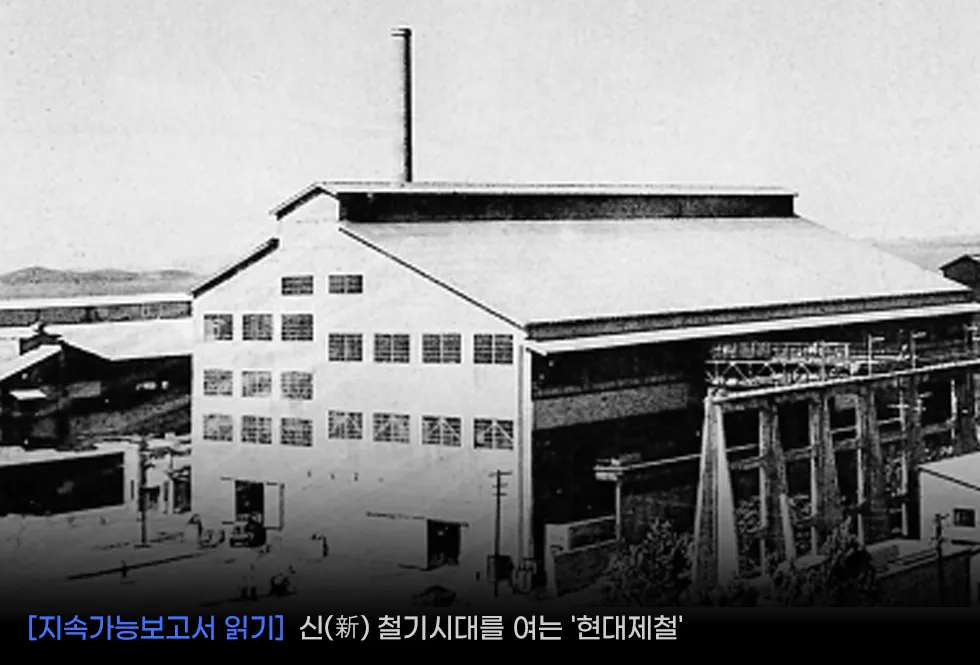
On June 10, 1953, even before the Korean War was concluded, "Hyundai Steel" began as "Daehan Heavy Industries Corporation." Hyundai Steel, which raised up the steel industry for the first time in Korea with the will to rebuild the nation over the ruins of war, is now counted among the world's top 10 steel companies. Let us look at the sustainability report of Hyundai Steel, driven by continuous innovation and a spirit of challenge.[A view of the brightly lit steelworks exterior © Hyundai Steel]WE Do in Sustainable H-waysHyundai Steel says that for a company's success, social responsibility for the "environment" is important. Under the slogan "We Do in Sustainable H-ways," meaning acting in a sustainable way, it set an ESG strategy framework of three practice directions: "eco-friendly management (Heritage)," "shared-growth management (Humanity)," and "right management (Harmony)."It also set six ESG promotion fields, establishing and practicing mid-to-long-term goals by field. Through this, it carries out activities that minimize environmental impact and also unfolds activities to protect natural capital, such as biodiversity conservation. Here, we will look at a few ESG areas that Hyundai Steel highlighted as major.[Byproducts from the metal-melting process are also recycled © Hyundai Steel]Hyundai Steel's Environmental ManagementTo improve the environment and reduce greenhouse gases, Hyundai Steel is actively working on environmental improvement, investing 680 billion won over five years starting in 2021. It also strives to develop recycling technology utilizing the byproducts that come out of the process of making molten iron. Hyundai Steel strives to create a clean environment with a thorough pollutant-management system and hazardous-chemical monitoring. Based on this direction, it is responding to the climate crisis by practicing the bold goal of carbon neutrality by 2050 and a phased reduction plan.It has also rolled up its sleeves to raise energy efficiency. With the goal of reducing energy use by 5% by 2027, it is working on company-wide energy saving. Executives directly preside over energy-saving meetings and oversee energy diagnostics by plant. It operates measures to prevent energy waste, such as developing a system that uses artificial intelligence to predict the temperature of coke ovens. In particular, it plans to reduce greenhouse-gas emissions by building "Coke Dry Quenching" equipment that recycles thermal energy. It is also practicing energy saving by introducing technology that raises the combustion efficiency of heating furnaces.[Ecosystem-protection program © Hyundai Steel]Implementing Ecosystem-Protection ProgramsHyundai Steel carried out endangered-species conservation projects near its sites such as Dangjin and Suncheon, together with partner organizations such as World Vision, the Korea Ecotourism Association, and the Citizens' Institute for Environmental Studies. In particular, by installing an "ecological ladder" for "improving the habitat environment of the gold-spotted pond frog" and carrying out environmental-cleanup activities, it provided an occasion for local residents and employees to pool their strength for environmental restoration together. It also ran the "I'm a Citizen Scientist Too" program, which provides ecosystem education and field experience for young people in the Dangjin area. This program, for the purpose of biodiversity education, has participants observe and record endangered species while learning the importance of biodiversity.It also conducted an "ecotoxicity assessment" to minimize the impact of wastewater discharge on marine ecosystems. As part of its efforts to minimize Hyundai Steel's impact on the environment, this also led to an eco-park project creating green space near its sites. Through such programs, Hyundai Steel continues to cooperate with local communities and join in sustainable development and the conservation of the natural environment. [Coffee-ground recycling and the "Anyone Bench" project © Hyundai Steel]Activities for a Society That Lives TogetherHyundai Steel is also carrying out various activities for social responsibility in the areas of the environment, safety and protection, and future generations. In the environmental field, it carried out a "coffee-ground (coffee waste) re-resourcing project" and an urban-forest creation project, "Making a Green Dong-gu." In particular, through coffee-ground re-resourcing, it also contributed to reducing local-community waste and creating jobs for vulnerable groups. In the safety-and-protection area, it expanded facilities for people with disabilities through the "Anyone Bench" project. The Anyone Bench, a convenience facility that both people with and without disabilities can use, drew attention with its user-friendly bench model design along with improving awareness of disability. On the sustainability front, Hyundai Steel continues efforts to enhance the welfare of the local community and stakeholders, providing investment of 17.1 billion won in social contribution and 88.5 billion won in shared-growth support.The "Korea Institute of Corporate Governance and Sustainability (KCGS)" evaluated Hyundai Steel with a "comprehensive A grade in ESG management evaluation." In addition, Hyundai Steel, also selected as a "Sustainability Champion" by the "World Steel Association (WSA)," established itself as an ESG-leading company in the global steel industry. We look forward to Hyundai Steel creating a future of sustainable growth through continuous strengthening of ESG management befitting its evaluations so far.By Editor L
"Quality Never Goes Out of Style."[The slogan of the jeans brand Levi's © Levi's]This is the slogan written on the label of "Levi's," a jeans brand loved by many. The paradox of a fashion brand talking about quality rather than style explains why this brand, which began in 1853, is still loved today. In modern society, fashion has established itself, beyond a part of the basics of living, as an element of economic value and cultural expression. But as awareness of this industry's negative impact on the environment has accumulated, it is being asked for sustainability, as recently in many fields. The fashion industry's carbon emissions account for about 10% of global greenhouse-gas emissions, which is more than the aviation and shipping industries combined. Water is used to the tune of 920 billion tons each year, an amount that 10% of the world's population could use for a year. The problem does not end here. Social problems — labor exploitation, low wages, and poor working environments that threaten underdeveloped and developing countries in pursuit of cheap production costs — are also not unfamiliar. Consumers now take an interest in such problems and choose friendly products. Furthermore, they also make a brand's ethical management an important purchase-decision factor. Because of this, sustainable fashion brands are increasing in the fashion industry, which is sensitive to consumer interest. Although their influence and results so far are slight, sustainable fashion brands have emerged to solve the burden of excessive resource consumption, using eco-friendly materials, recycling, and upcycling. They also leave declarations to fulfill social responsibility. Modern fashion brands are, beyond simply selling products, presenting a vision to make a better world. In this context, the clothing brand "Patagonia" launched "Patagonia School" in Korea in April 2024.The Reason "Patagonia School" Was Born: The Barrier That Is PatagoniaTo understand Patagonia School, let us refer to a comment left on a blog by Seo Jin-seok, a research fellow at Inno Social Lab who planned this project.*"In January 2017, the mission of the 'Beyond CSR, Patagonia' project was not simply to make Patagonia known. By presenting Patagonia as the North Star of CSR, it was to help change the direction of Korea's CSR. At the time it started, many knew Patagonia only simply as the company that ran the 'Don't Buy This Jacket' campaign, or did not know it properly. The North Star of CSR at the time was Yuhan-Kimberly. (...omitted...) Now, seven years later, it is hard to find anyone who denies Patagonia's status as the North Star of CSR. But rather, another barrier has arisen: dismissing Patagonia as an 'insurmountable wall' and writing it off as a different world."*To turn away from Patagonia because it does too well. Meaningful, but an ironic situation. So this project team felt the need to reset the mission it had set for itself, and after pondering from 2022, in April 2024, through the approval of headquarters, it established the "Patagonia Unfashionable Business School (hereafter Patagonia School)." For Patagonia School's curriculum and specific ideal, refer to the following:• First, a person who has a sense of calling in the fields of social innovation and ESG going forward, and who can educate and share problem awareness with people who will work hard from a social-change perspective.• Second, a person who can visit Patagonia's headquarters in Ventura, California, USA, and bring back discussion and inspiration.• Third, a person who recognizes that the current ESG is unsustainable — that a net-zero-centered strategy can never solve the environmental crisis and inequality — and who is capable of an Earth-ecosystem-centered approach.• Fourth, a person who can find their own direction as a participant.In-House Philosopher Vincent Stanley Becomes PrincipalPatagonia has an executive in charge of corporate philosophy. "Vincent Stanley," who serves as Director of Philosophy at Patagonia, was with founder Yvon Chouinard from the early days of the company's founding. Such a person took up the role of principal of "Patagonia School," established by Patagonia Korea. Having worked at this company for over 50 years, he is said to have accepted this role with expectation and hope for how the radical yet hopeful management philosophy Patagonia has shown will be applied to Patagonia School, and how this seed will connect to other countries. In a recent Hankyoreh 21 interview, he cited the following three items as reasons for the high level of cultural confidence Patagonia holds:["Vincent Stanley," Patagonia's Director of Philosophy and principal of Patagonia School © Patagonia]• First, the steady effort of the Chouinard family to "consider human happiness and the good of the Earth" in every decision we make.• Second, that most Patagonia employees made the same steady effort equally.• Third, that all employees have pride in the products and services we make.Patagonia School was planned and established by people from public enterprises, Patagonia Korea, social enterprises, and investment companies gathering together. The curriculum is said to have referred to Director of Philosophy Vincent Stanley's book "The Responsible Company." So it was all too natural that he took up the principal role himself. Patagonia School's first cohort, which began in April 2024, started with a total of 8 people. Even in the first semester, CSR and ESG officers from many companies are said to have applied. They conduct classes in the form of special lectures, presentations, discussions, and topic discussions until September, and in October they visit Patagonia's headquarters. The reason Patagonia School exists is to dream that, through such study, discussion, observation, and reporting, company workers become "seeds" that realize a new capitalism.Do Companies Have Souls Too?Patagonia, which answers this question loudly through a megaphone, supports the efforts of company workers connected to realizing CSR and ESG, as "seeds of a new capitalism" to confront the climate crisis. With the wish that those seeds, like dandelion spores, return to their respective places and become the new seeds of those companies.[The DON'T BUY THIS JACKET ad that made Patagonia known to the world © Patagonia]The brand Patagonia gives substance to a vision to make a better world, beyond a value of merely selling more goods. And it does it well. Patagonia School is closer to the story of a brand creating new possibilities beyond what Patagonia does well. The results are not yet known. But the inspiration this new experiment offers to the companies around it is certain.by Editor N
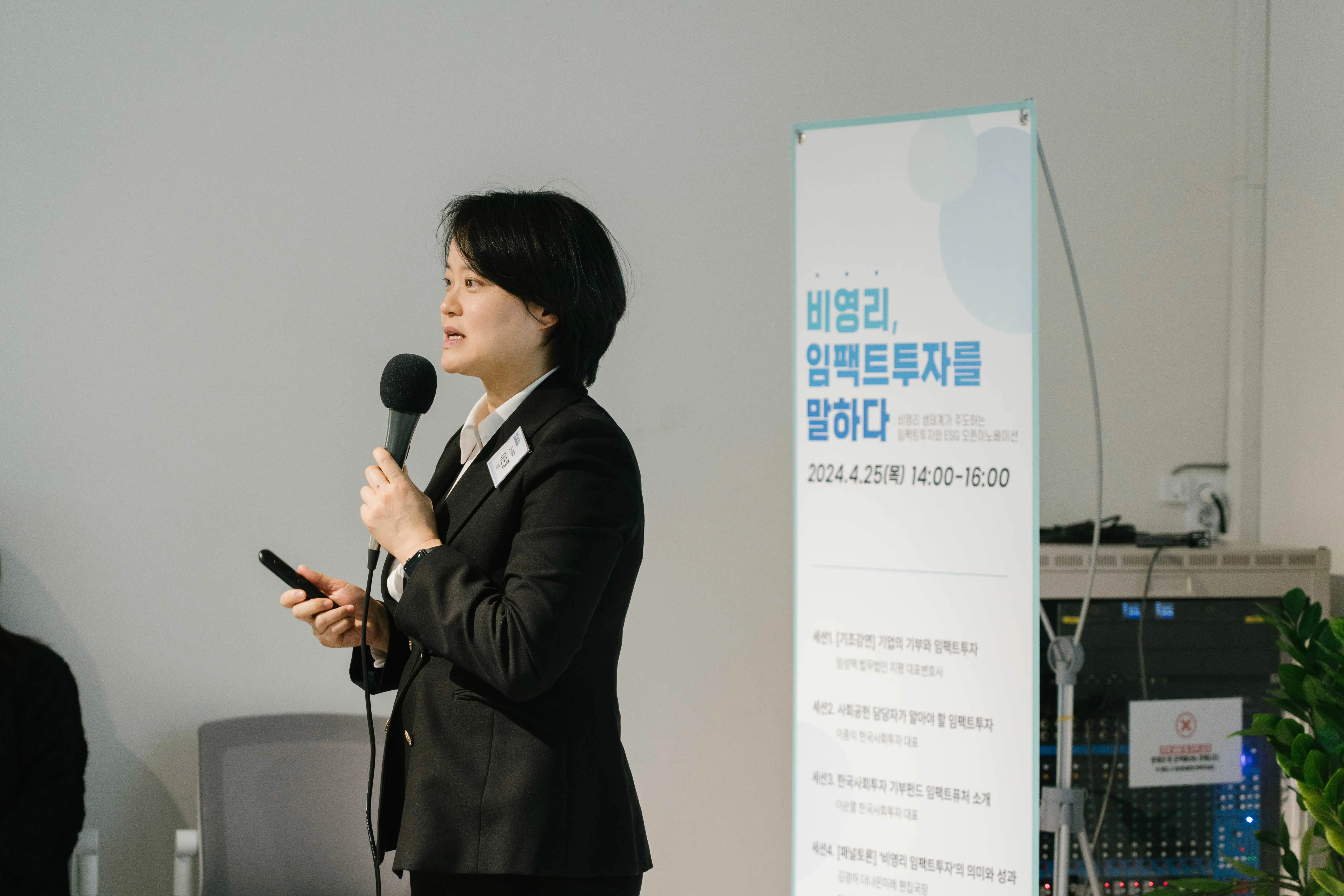
On April 25, Korea Social Investment (hereafter KSI) held a seminar under the theme "Nonprofits Speak of Impact Investing," together with experts from various fields — academia, the legal community, nonprofits, and the private sector. Through expert presentations and discussion, this seminar shone a light on donation-based nonprofit-ecosystem impact-investing activities and the results of ESG open innovation. Founded in 2012, KSI is an ESG and impact-investing firm that, under the mission "We support the growth of businesses that make a better world," focuses on investment in ESG and social-impact fields such as climate tech, social services, and agri-food.["Nonprofits Speak of Impact Investing" seminar © Korea Social Investment]"Impact investing," counted as the most active method among ESG investments, refers to investment that considers businesses which, through the investment, deliver not only returns but also a positive impact on society and the environment. It is similar to socially responsible investment (SRI)* in that it excludes so-called "bad companies" and invests in "good companies," but it differs in that it invests long-term, with concrete rates of return, in businesses that can exert a positive influence on social or environmental problems.*Socially Responsible Investment (SRI): a financial activity that invests in companies using not only their financial performance but also various social achievements — such as human rights, the environment, labor, and community contribution — as a yardstick."Impact Future," for the Sustainability of ESG StartupsThe donation fund "Impact Future," which KSI unveiled in February this year, began from a question like "What would 'impact investing' based on donation funds look like?" The main financial resource of Impact Future — which drives the sustainability of a future society by considering both the economic and the social aspects — is corporate donations. When investment capital is gathered through donations from various companies that are interested in or agree with the investment targets and fields KSI focuses on, investment is made in domestic startups and global impact companies after evaluating their impact-creation and social-problem-solving capacity, business sustainability, and more.That KSI could carry out impact investing at scale in earnest owes much to the "Hana ESG Double Impact Matching Fund," one of Hana Financial Group's ESG projects, in 2022. The Hana ESG Double Impact Matching Fund is operated with Hana Financial Group's donations, and it invests in 10 or more ESG startups each year, drawing out the business scale-up of companies and the spread of social impact. KSI CEO Lee Soon-yeol (hereafter CEO Lee) emphasized the role of donations, saying, "The most important thing when actually doing impact investing is to properly fulfill the role of capital," and, "In a situation where you must not only wait a long time after investing in a target company until full-fledged commercialization takes place, but where the possibility of an exit is also not high, donations must play the role of patient capital."[KSI CEO Lee Soon-yeol explaining Impact Future © Korea Social Investment]And as important as the "initial investment" that serves as the priming water for a company's commercialization is "follow-on investment." CEO Lee says, "Because the donation becomes first-loss capital, it can lower the investment risk and play the role of catalytic capital so that other for-profit capital can come in." In other words, once a company receives investment through Impact Future, it has been "verified" within the investment market as one that KSI has already invested in, making it easier to draw follow-on investment from other investment firms. In fact, when impact investing was carried out, the investment results also proved high. Korea Social Investment executed investments totaling 2.9 billion won in 24 startups in 2022, and totaling 2.7 billion won in 15 startups in 2023. To date, Korea Social Investment has executed investments in 53 startups, and two of them are already preparing for an IPO.*Exit: refers to an exit strategy after investment — a way for the investor to recover funds.The Virtuous Cycle of Investment to Be Achieved Through Impact FutureThere are for-profit and nonprofit institutions in impact investing too. One of the most important criteria is "who takes the returns when an investment profit is made." So then, who takes the investment profit generated at a company that received investment through Impact Future? The recovered investment profit becomes a business resource for Impact Future and a donation for yet another impact company, playing the role of patient capital and catalytic capital. Usually, even with impact investing, if the investment is made through a for-profit investor, the owner or shareholders take the investment profit as dividends; but in the case of a nonprofit organization, because there is no owner, when profit arises it does not end up as a specific person's profit. Therefore it can be reinvested, and the "virtuous cycle of finance" — most important in impact investing — can also be realized. It is a structure in which, as a company's business is run sustainably, social value is also continuously created, and those results return to the donor so that investment can continue — a structure where company and company can each win (win-win).[(From left) Lee Soon-yeol, CEO of Korea Social Investment; Jang Hee-jin, Deputy General Manager of Hana Financial Group's ESG Planning Team; Jeong Ho-yoon, Head of Management Innovation at World Vision; Kim Kyung-ha, Editor-in-Chief of The Better Future; Lee Ji-hwan, Professor of Management Engineering at KAIST; Lee Hye-mi, Director of Korea Social Investment © Korea Social Investment]At the seminar that day, a panel discussion under the theme "The Meaning and Achievements of Nonprofit Impact Investing" was also held so that participants could gain insight related to nonprofit impact investing. Asked what the achievements would be of using impact through corporate donations and of operating a donation fund through social contribution or ESG activities, Lee Ji-hwan, a professor of management engineering at KAIST who participated in the panel discussion, emphasized the value that the expanded reproduction of impact investing through donation provides. "As part of impact investing, by donating to sustainable businesses, they can run self-sustainingly without an organization, and there is ample room to use this to draw a new S-curve (growth curve) in an existing business." He also explained that corporate participation is important, saying, "If large corporations actively step up to operate donation funds, the effect spreading across society as a whole will of course occur greatly," and, "Ultimately, we will be able to achieve a greater effect in solving the social problems we seek to solve."Social problems are becoming more advanced by the day. As the saying goes, "Let companies solve social problems. The answer is in companies," to solve social problems more surely, we cannot but call for companies' interest and active movement. KSI's Impact Future will become a novel and meaningful investment model in social and environmental terms. We look forward to the expansion of ESG investment through donation funds bringing a greater impact to our society.by Editor L