Loading Data
Please wait a moment...
Update Cal.
2026.08
03
Mon
04
Tue
05
Wed
06
Thu
07
Fri
08
Sat
09
Sun
Update Calendar
2026.08
01
Sat
02
Sun
03
Mon
04
Tue
05
Wed
06
Thu
07
Fri
08
Sat
09
Sun
10
Mon
11
Tue
12
Wed
13
Thu
14
Fri

Loading Data
Please wait a moment...
Evening ESG news and briefings to wrap up your day.

The government has extended the vehicle fuel tax cut until July 31, and international flight fuel surcharges will also drop by approximately 20% from June compared to their peak levels. Both measures aim to ease the burden on the public amid soaring oil prices triggered by the Middle East war, but from an ESG perspective, these two measures create a tension between Environmental (E) and Social (S) considerations. Seemingly Similar but Different: Fuel Tax Cuts vs. Fuel Surcharge Drops [Vehicle Fuel Tax Comparison Table© ESG.ONL] First, it is necessary to distinguish between the nature of the ‘fuel tax cut’ and the ‘fuel surcharge drop.’ The vehicle fuel tax cut is a policy decision in which the government directly adjusts tax rates. On May 21, 2026, the Ministry of Economy and Finance convened a meeting of the Special Task Force (TF) of relevant ministers for livelihood price management and announced that the fuel tax cut, originally scheduled to expire on May 31, would be extended for two months until July 31. The reduction rates remain unchanged at 15% for gasoline and 25% for diesel. Accordingly, the per-liter fuel tax will continue to apply at the reduced rates of ₩698 (down from ₩763) for gasoline and ₩436 (down from ₩523) for diesel. Compared to pre-cut rates, this translates to a reduction effect of ₩122 per liter for gasoline and ₩145 per liter for diesel at consumer prices. [Korean Air Boeing 787-10 © Korean Air Official Website]In contrast, the decline in aviation fuel surcharges is not a government decision but an automatic adjustment linked to international oil prices. Aviation fuel surcharges are calculated across 33 tiers based on the daily average price of jet fuel traded on the Singapore spot market (Mean of Platt’s Singapore Kerosene, MOPS), and are reflected in the following month’s ticket issuance on a monthly basis. After the Middle East war broke out in February 2026, the highest tier, Tier 33, was applied to May ticket issuances, but with expectations of war negotiations and declining international oil prices, from June issuances onward it has been adjusted downward by six tiers to Tier 27. Based on Korean Air standards, round-trip fuel surcharges for the longest-haul routes such as to New York have dropped from ₩1,128,000 to ₩903,000, a reduction of ₩225,000. The Fuel Tax Dilemma: Between Climate Goals and Vulnerable PopulationsThe fuel tax is not simply a tax. It functions as a ‘carbon price signal’ that imposes a cost on fossil fuel consumption to suppress usage and encourage the transition to eco-friendly alternatives. Lowering the fuel tax reduces the short-term burden on consumers, but in the long term, it may increase fossil fuel consumption and greenhouse gas emissions — moving in the opposite direction of carbon neutrality.South Korea has declared carbon neutrality by 2050 as a statutory goal and submitted a Nationally Determined Contribution (NDC) to the United Nations of reducing greenhouse gases by 40% by 2030 compared to 2018 levels. The Organisation for Economic Co-operation and Development (OECD) has consistently pointed out that fossil fuel subsidies and fuel tax cuts conflict with carbon neutrality goals. The more the fuel tax cut becomes a repeated practice rather than an emergency response, the lower international trust in South Korea’s carbon reduction pathway will inevitably fall. [Framework Act on Carbon Neutrality and Green Growth for Climate Crisis Response © Carbon Neutrality and Green Growth Commission] That said, the fuel tax cut cannot be evaluated solely on environmental grounds. The damage from soaring oil prices is not evenly distributed. The impact of surging fuel prices is far greater for residents of rural areas with limited access to public transportation, workers in freight and transportation industries whose livelihoods depend on fuel costs, and small business owners for whom energy costs constitute a significant portion of their expenses. This is the context behind the Ministry of Economy and Finance applying a higher reduction rate of 25% to diesel, considering the ripple effects on industrial and logistics sectors. With consumer price inflation recording a 2.6% year-on-year increase last month — the steepest rise in roughly 21 months — leaving energy price increases unchecked would amount to directly shifting the burden onto socially vulnerable groups. To Achieve Both Livelihood and the EnvironmentUltimately, this fuel tax cut is a policy where you gain one thing and lose another. As a temporary crisis response, the fuel tax cut is an unavoidable choice. However, the more the reduction is repeated and prolonged, the more necessary it becomes to verify whether its benefits are sufficiently reaching the truly vulnerable, and how it will connect with post-expiration eco-friendly transition support policies. Rather than uniformly cutting the entire fuel tax, more precise alternatives could include expanding energy vouchers for low-income households and small business owners, or EV transition subsidies.This fuel tax cut debate serves as a reminder that ESG is not merely an eco-friendly campaign but a practical decision-making framework for striking a balance between the dual values of Environment and Social. by Editor N
Early voting for the June 3 local elections begins in three days. What choice should we make? If you have not yet decided, it may be worth consulting the ‘2026 Local Election 10-Domain Climate Policy Proposal (hereinafter the Proposal).’ Jointly announced on May 21, the first day of the official election campaign period, by Climate Politics Baram, Cultural Solidarity, and Citizens’ Coalition for Walkable Cities, the Proposal is a policy proposal presented by civil society as a framework for vetting candidates. Under the banner of ‘Reduce Carbon, Increase Welfare,’ it contains a total of 30 policies across 10 domains. Civil society has taken the initiative in providing criteria, from Environmental (E), Social (S), and Governance (G) perspectives, for evaluating the pledges of metropolitan and local government heads.[2026 Local Election 10-Domain Climate Policy Proposal © Green Transition Institute]The 10 domains covered by the Proposal are: ▲Region-Led Carbon Neutrality Policy ▲Energy Transition ▲Mobility Rights ▲Housing Rights ▲Education ▲Green Jobs ▲Climate Care ▲Agriculture & Food ▲Ecology ▲Resource Circulation. As the slogan suggests, the policy focus is oriented toward reducing the burden on citizens. The common goal across the 30 policies is to create regional circular structures for transportation costs, heating and cooling costs, food costs, energy, jobs, food, and care. In this way, the Proposal places weight on articulating concrete items through which citizens can experience and verify climate pledges. In the publication statement, civic groups argued that “voters must directly seek out and scrutinize the climate pledges that local election candidates have not put forward,” and that “they must demand that candidates strengthen their climate pledges and policies by election day.”Analysis Also Shines Light on Governance Blind SpotsAmong the quantitative data presented in the Proposal, there are figures worth noting from the ESG Governance perspective. A comprehensive analysis by the Green Transition Institute of the 1st Carbon Neutrality Master Plans of all 226 local governments revealed that the average 2030 carbon emission reduction rate was 25.3%, falling short of the Nationally Determined Contribution target of approximately 40% reduction from 2018 levels. A total of 87 local governments (38.5%) received a D grade, requiring a full-scale redesign.The state of governance operations is even more deficient. Among the 226 local governments, only 147 (65.0%) have actually constituted and are operating a Carbon Neutrality and Green Growth Commission, and even those that are constituted have been limited to holding just 1–2 meetings per year on average. Only 7 (3.1%) operate subcommittees dealing with more detailed agendas. The fact that 28.5% of appointed members are concentrated in academia and research, while labor and farmers account for only 2.0% and youth and students for just 1.3%, is also disappointing from a diversity perspective. Among the 147 operating commissions, 51 (34.7%) were found to be male-dominated in violation of statutory gender balance provisions. This is the backdrop for the Proposal’s first domain — ‘Region-Led Carbon Neutrality Policy’ — calling for a citizen-participatory plan redesign and the establishment of a climate deliberation body.The disparity in the energy domain is also clear. As of 2024, South Korea’s renewable energy generation share stands at approximately 9%, just one-third of the OECD average (31.0%). While Germany installed an additional 430,000 balcony solar units in 2024 alone, South Korea remains at the initial stage for both institutional frameworks and deployment infrastructure. Energy-poor households are estimated at 1.58 million, and homes aged 30 years or older total 5,563,000, accounting for roughly 28% of all housing. The Proposal’s ‘One Household, One Solar’ deployment system and ‘Grand Housing Renovation’ are policy cards directly targeting these disparities.[2026 Local Election 10-Domain 30 Climate Policy Proposals © Green Transition Institute]Partial Alignment Between Proposal and Candidate PledgesExamining metropolitan government head candidates’ pledges against the 30 policy items presented by civil society reveals variation in the degree of alignment by domain. In the mobility sector, Democratic Party Seoul mayoral candidate Jeong Won-o’s pledge for ‘full expansion of the Climate Companion Card across the metropolitan area’ points in the same direction as the Proposal’s call for expanding flat-rate climate passes. Data showing 20 million cumulative Climate Companion Card top-ups and 800,000 monthly users were even cited in the Proposal itself as evidence of policy effectiveness. In the green jobs sector, Democratic Party candidate Kim Young-rok’s pledge for 2 million pyeong of RE100 industrial complexes as Governor of the integrated Jeonnam-Gwangju Special City partially aligns with the Proposal’s call for offshore wind and renewable energy industrial belt creation.Conversely, some domains are key items in the Proposal yet rarely appear in candidate pledges. The ‘Grand Housing Renovation’ policy in the housing rights domain barely features in core metropolitan government head pledges, despite the building sector accounting for 22.2% of domestic greenhouse gas emissions. The protection of climate-vulnerable groups, mandated by the amended Framework Act on Carbon Neutrality that took effect on April 7, is only mentioned at the party level — the Democratic Party’s ‘Climate Insurance’ and the Rebuilding Korea Party’s ‘Climate Allowance’ — while implementation plans at the metropolitan government head level remain rare.Another signal of party-level interest was evident at the debate hosted by Climate Politics Baram on May 7. While officials from the Democratic Party, Rebuilding Korea Party, Progressive Party, and Justice Party attended the mayoral and gubernatorial debate, the People Power Party and New Reform Party did not respond to the organizer’s invitation.[‘Climate Pledges That Change My Life: Are Mayors and Governors Ready?’ Debate Venue © Green Transition Institute]By-Elections as a Legislative VariableThe 14 National Assembly by-elections being held on the same day are also a variable. This is because the legislative momentum for bills pending in the 22nd National Assembly — such as the ESG Adoption and Promotion Support Act, the SME Carbon Neutrality Support Act, and the RE100 Industrial Complex Special Act — will be influenced by the election results. While metropolitan and local government heads will steer policies for the next four years, the composition of the National Assembly that will provide the legal basis for those policies is being decided on the same day. The Proposal also addresses the division of roles between local and central governments. In the publication statement, the civic groups noted that “while the central government can secure funding and introduce institutions for carbon neutrality, the actual realization of climate response requires local governments, regional communities, and citizens to act,” and that “the success or failure of the Nationally Determined Contribution ultimately rests with local governments.”Ko Yi-ji-sun, Regional Transition Team Lead at the Green Transition Institute who oversaw the drafting of the Proposal, explained in the press release that “the emphasis was on restructuring climate policy not as a mere environmental agenda but as a civic livelihood agenda,” and that “both candidates and voters must recognize that policies that substantively reduce transportation, heating, cooling, and food costs are the very policies that reduce carbon.” In particular, the ‘Region-Led Carbon Neutrality Policy’ — which the Proposal placed as the first domain — calls for establishing carbon neutrality targets before 2050, installing dedicated carbon neutrality organizations, creating regional climate funds, and redesigning citizen-participatory plans, all of which must be initiated in the first year of the elected official’s term. The extent to which the 30 items flagged by the Proposal take root in local administration within the four-year term will also provide a rough outline of the ESG report cards of South Korean local governments in 2030. by Editor N
The Stewardship Code, a self-regulatory code requiring institutional investors to responsibly engage in the management of their investee companies, is undergoing a full-scale overhaul after ten years since its introduction. Since its domestic adoption in December 2016, a total of 249 institutional investors have joined, including the four major pension funds — National Pension Service, Government Employees Pension Service, Teachers’ Pension, and Korea Post — as well as asset management firms, insurers, and venture capital firms. While the scale has grown compared to the early days of adoption, its effectiveness remains in question. According to a December 2025 report by the Korea Capital Market Institute, among 72 participating institutions including pension funds, asset managers, insurers, securities firms, and banks, only 10 had published a Stewardship Code implementation report. Even those that did publish were limited to pension funds and asset managers, with no confirmed cases among insurers, banks, or securities firms. [Stewardship Code Implementation Report Publication Status © Korea Capital Market Institute]Measures to Substantiate the Stewardship Code The UK has revised its Stewardship Code three times since its introduction in 2010, and Japan has also been steadily refining it, yet South Korea has not had a single revision since enacting its Stewardship Code in 2016. Change began in December 2025. The Stewardship Code Development Committee and the Korea ESG Standards Institute, together with relevant ministries and agencies including the Financial Services Commission and the Ministry of Health and Welfare, announced measures to substantiate the Stewardship Code. The core of the substantiation effort has three pillars.First, the formalization of implementation review procedures. Participating institutions must submit self-reports on 12 items including fiduciary duty policies, conflict of interest management, and voting rights exercise, and the ESG Standards Institute will practically review these self-reports through the implementation review process. Second, the integration of the disclosure system. Implementation reports that were previously scattered across each institution’s website will be collectively posted on a dedicated Stewardship Code website, and a comprehensive report enabling inter-institutional comparison of item-by-item implementation levels will also be published. Third, the revision of the Stewardship Code content itself. The scope of fiduciary responsibility, which was previously centered on governance (G) within ESG such as board composition and governance transparency, will be expanded to include environmental (E) and social (S) considerations, and the application of stewardship principles at the investment selection stage is also under review. The Stewardship Code Development Committee plans to prepare amendments to the code and detailed guidelines within the first half of 2026.[Stewardship Code Implementation Review Items by Principle © Korea ESG Standards Institute]From Pro Forma Participation to Subject of Real ScrutinyIn tandem with the institutional overhaul, the National Pension Service, the largest institutional investor, has also picked up pace. President Lee Jae-myung directly ordered the strengthening of the Stewardship Code at a work report session with the Ministry of Health and Welfare and its affiliated institutions, stating that “the National Pension Service must actively exercise its voting rights in companies with backward management practices.” The National Pension Service is pursuing plans to establish separate fiduciary responsibility activity standards for outsourced managers and to reflect inspection and evaluation results in fund allocation and redemption. Concrete examples have already emerged: the National Pension Service voted against SK Hynix’s proposal to dispose of treasury shares for employee compensation purposes at its shareholders’ meeting.Starting this year, the Financial Supervisory Service will inspect asset management firms’ Stewardship Code implementation status and disclose the evaluation results. The scope of inspection will begin with 68 asset management firms and pension funds in 2026, and expand in phases to private equity fund managers and insurers in 2027, securities firms, banks, and investment advisory firms in 2028, and to venture capital by 2029. Internal controls and compensation systems for private equity fund managers will also be reformed. The Financial Supervisory Service indicated that corporate leaders need to personally inspect performance-based compensation structures and internal organizations.After Japan introduced its Stewardship Code in 2014, institutional investors actively demanded shareholder returns from undervalued companies with low Price to Book Ratios (PBR). Companies responded with share buybacks and expanded dividends, and as a result, the Nikkei index, Japan’s benchmark stock index, more than tripled over the course of a decade. This is a case where the Stewardship Code went beyond mere normative dimensions to transform the fundamental character of the entire capital market. Once the Stewardship Code amendments are finalized in the first half of this year, those standards will immediately set the bar for investors. This is precisely why companies should now review their internal ESG management systems and disclosure readiness. by Editor N

Texas Senate Bill 13 (SB 13), enacted in 2021, is an ‘anti-ESG law’ that restricts government dealings with financial institutions that boycott the fossil fuel industry. On February 4, 2026, Judge Alan D. Albright of the U.S. District Court for the Western District of Texas ruled SB 13 unconstitutional, finding that it violates the First Amendment’s freedom of speech and the Fourteenth Amendment’s due process. A local government law targeting financial institutions that turn away from fossil fuels was thus blocked by the courts. The Collision Between the Fossil Fuel Industry and ESGSince the late 2010s, ESG-conscious investing has grown rapidly in the global investment industry. This worked to the disadvantage of fossil fuel companies, as an increasing number of financial institutions declared they would not invest in coal, oil, or natural gas companies on climate change grounds. The problem began in earnest when global mega financial institutions such as BlackRock publicly declared in Texas — America’s largest oil-producing state — that they would “reduce investment in fossil fuel companies.” When large investors pull out, fossil fuel companies find it harder to raise funds, and stock prices fall, posing a threat to the very foundation of Texas’s regional economy.[Texas Oil Plant © gettyimages]To address this, the Texas state government enacted SB 13 in 2021. Specifically, SB 13 is divided into two provisions. The first is the ‘divestment provision.’ The Texas Comptroller compiles a list of financial institutions deemed to be boycotting fossil fuels and notifies those institutions. If a listed institution fails to cease its boycott activities or demonstrate a legitimate business purpose within 90 days, it becomes subject to divestment. In that case, the institution must phase out its holdings of securities: 50% within 180 days and 100% within 360 days. The second is the ‘contract prohibition provision,’ requiring companies with 10 or more employees and contracts totaling USD 100,000 or more to attach verification stating they will not boycott fossil fuel companies. In practice, global mega financial institutions such as BlackRock and French bank Société Générale were among those listed as entities subject to SB 13. Rising Borrowing Costs and the Policy Paradox[Rising Texas Bond Yields © ChatGPT/ESG.ONL]Paradoxically, SB 13 shifted costs onto Texas residents. The Texas state government issues bonds when it needs money for public projects such as roads or schools, but when large financial institutions were excluded from the dealing list under SB 13, bond purchases declined. With fewer bidders, Texas had to promise higher interest rates for its bonds to sell, and that interest comes out of the state budget — in other words, residents’ taxes. The law created to protect the fossil fuel industry for the sake of the region ended up increasing the tax burden on Texas residents. The Brookings Institution, a U.S. policy research organization, analyzed that in the first eight months after SB 13 took effect, Texas public entities incurred an additional USD 300–500 million in interest on USD 32 billion in borrowing.The Future of SB 13 Amid Ongoing Legislative Battles[U.S. Federal Court Ruling © ChatGPT/ESG.ONL]Texas appealed the ruling two days later, on February 6. Depending on the appellate outcome, SB 13 could be revived or could disappear entirely. Multiple U.S. states beyond Texas — including Alabama, Arkansas, and Kentucky — are also operating similar laws. If the ruling is upheld on appeal, a cascade of lawsuits over similar rulings could follow.It is difficult to view this ruling as having been issued in favor of ESG-conscious investing. The court found the law unconstitutional because the definition of ‘boycott’ was so broad that even the expression of opinions became subject to punishment — not because regulating actual refusal to transact with fossil fuel companies is itself unconstitutional. If Texas were to narrow the definition of boycott and re-enact the law to punish only the actual refusal or reduction of transactions, a structure could be created in which financial institutions that do not invest in fossil fuel companies are expelled from Texas. Legal experts predict that Texas may attempt to pass amended legislation with a narrowed definition. The federal court ruling may have, from Texas’s perspective, provided an opportunity to craft a more precise law. The battle over what criteria should guide corporate investment will continue inside and outside the courtroom, and beyond Texas as well. by Editor N

The ‘Food Safety Day’ observed every year on May 14 was designated to raise awareness of food safety and promote a safety-conscious mindset among food industry workers. Established by the Ministry of Food and Drug Safety (MFDS) in 2002, it was elevated to a statutory commemorative day through a 2016 amendment to the Framework Act on Food Safety. Now, ten years after becoming a statutory day, the meaning of ‘food safety’ has transcended the realm of simple food hygiene management. On Food Safety Day, we contemplate not only the safety of food but also the agenda of a society where everyone can eat safely without any members being left behind. From an ESG perspective as well, food safety is understood as an issue demanding responsibility toward the socially vulnerable and an institutional safety net.Food Deserts That Still ExistNear Exit 6 of Seoul’s Yeongdeungpo Station, by the roadside, stands a soup kitchen called ‘Thomas’s House.’ Opened in 1993, this soup kitchen provides lunch at a price of 200 won each day to homeless individuals, elderly people living alone, and jjokbang (small single-room dwelling) residents in the surrounding community who have difficulty feeding themselves. Serving an average of over 300 people daily, it has held its place for more than 30 years through the efforts of volunteers and individual donors, without support from local governments or the national government. It is a symbolic place showing that blind spots in the food safety net still exist in our society. Socially vulnerable groups such as children, the elderly, and persons with disabilities find it difficult to secure balanced nutrition on their own, and in the absence of systematic societal management, they are easily exposed to nutritional imbalances. It is also a reality that members of environments where hiring a professional nutritionist is difficult — such as small childcare centers or welfare facilities for the disabled — can hardly be guaranteed adequate hygiene management or nutritional balance. For food safety to establish itself as a social responsibility, a cooperative operational system tightly connecting the government, public institutions, and local governments is necessary.Nutrition Management Supported by the Food Safety Management InstituteTo build a food safety net, the MFDS is responsible for overseeing food safety policies based on the Framework Act on Food Safety, while local governments are entrusted with establishing and operating Children’s and Social Welfare Meal Service Management Support Centers to provide locally tailored services.[Customized In-Depth Nutrition Management Special Project run by the Jincheon County Children’s and Social Welfare Meal Service Management Support Center in 2025 © Jincheon-gun, Chungcheongbuk-do]The MFDS, in cooperation with its affiliated institution the Food Safety Management Institute, has established a meal service support system for vulnerable groups. The Food Safety Management Institute supports the improvement of dietary safety for nutritionally vulnerable groups through two key programs. The first is the operation of the Children’s Meal Service Management Support Centers. At these centers, responsible nutritionists make direct visits to small childcare centers and child welfare facilities that are not required to employ a nutritionist, providing巡回 guidance on hygiene and nutritional status. The centers also develop customized educational materials for children, provide tailored menus and standardized recipes, and conduct dietary education for children, kitchen staff, and parents.The second key program is the operation of the Social Welfare Meal Service Management Support Centers, which began in 2023. These centers support customized hygiene and nutrition management for small-scale elderly and disabled welfare facilities that lack a nutritionist. Specifically, they design meal plans that account for the physical conditions and health status of elderly and disabled individuals requiring social care, and conduct hygiene inspections of cooking environments.A Safe Meal That Must Be Guaranteed for AllRecently, in addition to the on-site visit support approach for food safety, the MFDS also operates digitally-based management programs to enhance transparency. A representative example is the website ‘Food Safety Korea’ operated by the MFDS. On this website, consumers can access the food history information menu, enter a product name or company name, and view information on every stage from production to sale. Food Safety Korea also offers a safety management certification product verification service, serving as a window through which consumers can access food safety information.[Screen of the Food History Information Search menu on the Food Safety Korea website © Food Safety Korea]When the institutional efforts of public agencies including the MFDS meet the dedication of private organizations like Thomas’s House, the food safety net will become even tighter. A safe and balanced meal for sustaining life is a universal right that must be guaranteed to every member of society, and a sustainable society is one where all members can sit at a safe table equally. Food Safety Day is one small step in that direction. by Editor N
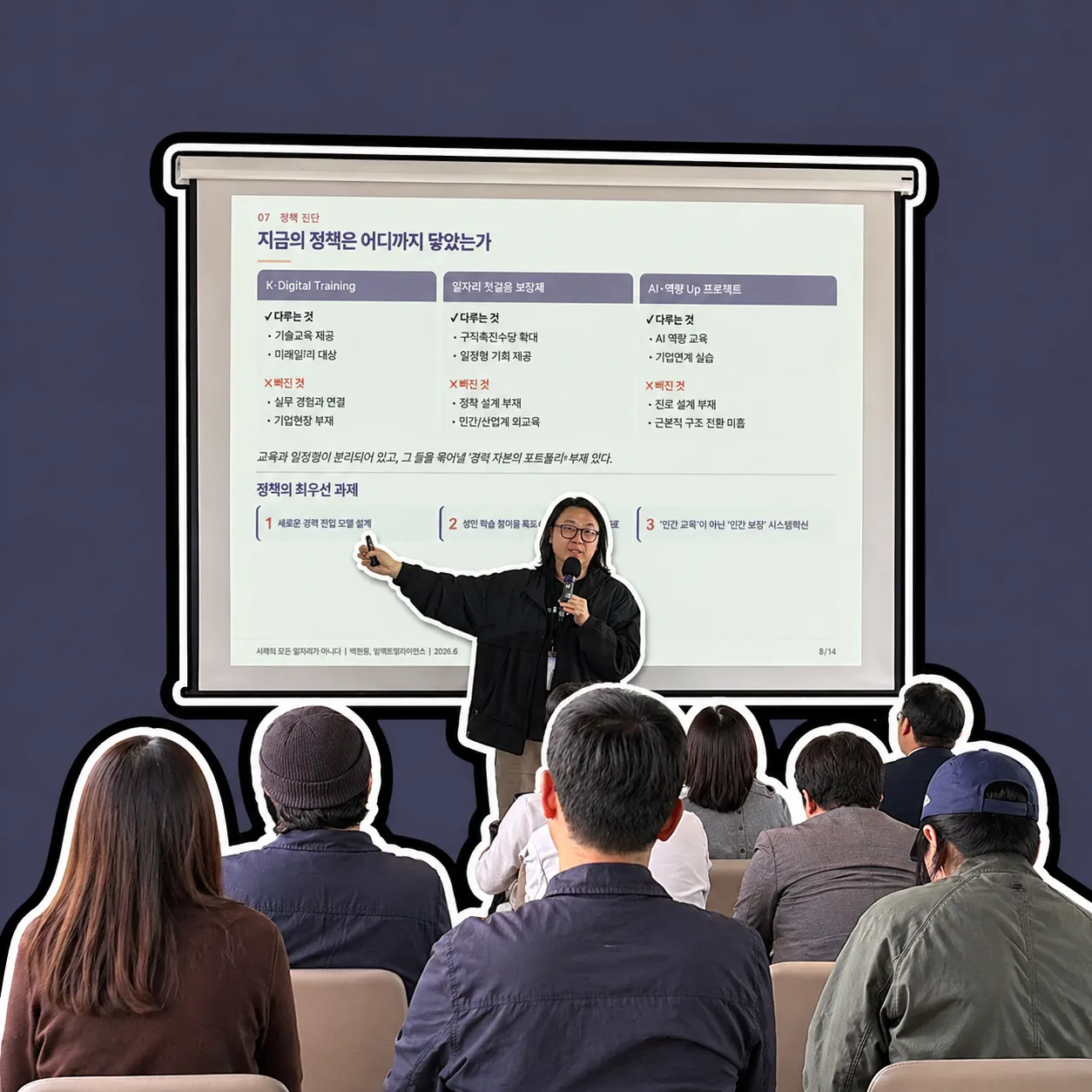
The discussion that AI Transformation (AX) replaces jobs is no longer unfamiliar. The ‘AI Basic Society Action Seminar,’ held on April 23 at Seongsu Heyground hosted by the Underdogs Impact Alliance, went a step further. At the seminar, the conversation centered on who is being left behind in this transition and whether the newly opening jobs are genuinely open to everyone.[Bank of Korea analysis data © Based on Bank of Korea data/ChatGPT]According to Bank of Korea analysis, from July 2022 to July 2025, youth jobs in their 20s and 30s decreased by 211,000, while jobs for those in their 50s increased by 209,000 during the same period. A striking 98.6% of the decline was concentrated in industries with high AI exposure. It was not that the total volume of jobs had vanished, but that a generational shift had occurred. In a Stanford University seminar this past January, Harvard Economics Department graduate students Hosseini and Reitinger presented the results of an analysis of resume data for 62 million workers across 620,000 U.S. companies. They found it significant that the jobs AI is replacing first are not low-difficulty ‘easy work’ but rather ‘junior work.’ Tasks considered junior work — such as standardized document editing, information retrieval, and entry-level coding — are not simply easy tasks. They are the process through which new hires first learn the organization, make mistakes, receive feedback from senior colleagues, and build their professional instincts. That process is quietly disappearing.What the AI Basic Society Asks[AI+ Skill Up Project ©Ministry of Employment and Labor Instagram]The ‘AI Basic Society’ promoted by the government is a vision of making AI a public infrastructure for all citizens, not just a tool for some experts. The Ministry of Employment and Labor plans to support the AI vocational skills development of one million people in the labor market over the next five years, and to invest a total of KRW 254 billion in 2026 to train approximately 240,000 AI personnel. This spans the entire life cycle, from jobseekers to current employees to career changers. At the seminar, shortcomings regarding this policy were aired. It was noted that while current policies reach the point of connecting education provision to work experience, what comes after is left to individuals. Programs are multiplying without a designed connection from internships — where career capital actually accumulates — to employment, and from employment to growth.[AI Works Curator Lee Hye-min speaking on ‘Inclusive AX Job Creation for Vulnerable Groups’ © ESG.ONL]Nevertheless, there are already parts that are working on the ground. AI Works is implementing a roadmap that transforms the job functions of workers with disabilities — who had mainly handled simple repetitive tasks — through the stages of AX education, intellectual property creation, and revenue model proliferation. It is an example of redefining the automation of repetitive tasks not as a threat but as a catalyst for transition. At regional youth startup sites, AI agents have begun to supply resources that previously did not exist. In environments with no developers, no designers, and no mentors, AI is taking over coding, marketing, and market research, and a change is emerging in which the execution capability gap between the capital region and local areas is narrowing.Models That Must Be Built on the GroundHowever, for such experiments to become the standard rather than the exception, the role of companies must change. The AI utilization rate stands at 49.2% for large enterprises versus 4.2% for SMEs — a twelvefold difference. Given that 89.1% of all workers in South Korea are employed by SMEs, this gap is effectively a gap in overall productivity. This is why it is critical for companies to open their AI infrastructure and training programs to SMEs and local communities.Social jobs in the AX era are not a substitute for low-value-added jobs. They are jobs that bridge the technology gap, maintain services in which human interaction is key, and support the transition of vulnerable groups. The OECD has analyzed that social economy organizations can serve as a ‘buffer zone’ for the employment of vulnerable groups during the AI transition. What must be designed now is not the total volume of jobs, but pathways through which people can grow. For the AI Basic Society to become a society for everyone, those pathways must not be open only to certain groups. by Editor N

The Green Transformation International Week (GX International Week) and Climate Change Week kicked off on April 20. At this event hosted by the Ministry of Climate, Energy and Environment, 16 institutions and organizations spanning government, public agencies, and private companies are introducing carbon neutrality practice cases and information at outdoor booths at the Yeosu Venezia Convention site. If you are planning to visit Yeosu during this special week, take note of the booths that ESG Today has highlighted.① Ministry of Climate, Energy and Environment — Promoting GX International Week and Climate Change Week Is Climate Action ItselfThe Ministry of Climate, Energy and Environment, which organized this event, is running an event in which souvenirs are given to those who share messages of support for GX International Week and Climate Change Week on social media. It is participatory promotion that naturally spreads the purpose of the event, conveying the message that climate action is not something far away.[Ministry of Climate, Energy and Environment booth at the venue entrance © ESG.ONL]② Presidential Commission on Carbon Neutrality and Green Growth — Figuring Out the Gains of Green Activities with ‘Green Pig Geudeuki’The Presidential Commission on Carbon Neutrality and Green Growth is operating an information booth where visitors can check everything from the commission’s organizational structure to its major activities at a glance. The Chairperson personally attended the GX International Week opening ceremony and emphasized the commission’s role. The booth is drawing visitors with an event giving away items featuring the character ‘Green Pig Geudeuki,’ which introduces the benefits that can be gained through green activities.[Event booth of the Presidential Commission on Carbon Neutrality and Green Growth © ESG.ONL]③ Korea Environmental Industry and Technology Institute — Even a Seal Knows Carbon Neutrality Points, Plus Double Earning TipsAt the booth of the Korea Environmental Industry and Technology Institute, where a cute seal character catches the eye, the Carbon Neutrality Point system is intensively introduced. It explains how to earn points and receive incentives through everyday green activities such as issuing electronic receipts, using reusable containers, and recycling, and also shares information about limited-time events for earning double points.[Korea Environmental Industry and Technology Institute seal character and event booth © ESG.ONL]④ Climate Solutions — Discovering the Truth of 1.5°C While Making Your Own SandwichThe most eye-catching booth is undoubtedly the Climate Solutions booth, decorated in a red bakery concept. Centered on the theme of global efforts to limit Earth’s temperature rise to within 1.5°C and the impacts of the climate crisis, it operates a hands-on activity in which participants complete a sandwich by connecting sandwich ingredient cards, each containing a piece of climate knowledge. The method of learning climate information by assembling it with one’s own hands is drawing the interest of participants.[Climate Solutions booth where participants learn about climate crisis information by choosing bread and ingredients © ESG.ONL]⑤ H&M — Fashion Asks About SustainabilityAt this event, H&M — the only fashion brand — conveys its sustainability message through an O/X quiz format participation event. From Earth Day-related general knowledge to the procurement methods of the materials H&M uses in its products, the brand unpacks its eco-friendly efforts through quizzes in a natural way. [H&M event booth drawing interest through a quiz game © ESG.ONL]⑥ Sudogwon Landfill Site Management Corporation — Feeling the Possibility of Regeneration Through Sock Toe OffcutsThe Sudogwon Landfill Site Management Corporation, which manages and processes waste discharged by 26 million citizens in the Seoul metropolitan area including Seoul, Gyeonggi, and Incheon, operates a hands-on activity of making pot holders from recycled sock toe offcuts. During the activity, guides explain the corporation’s role and the importance of resource circulation, helping participants to directly feel how meaningful the process of reducing and regenerating waste can be.[Sudogwon Landfill Site Management Corporation information booth offering sock toe offcut item making © ESG.ONL]The GX International Week promotion booths are open from 10 AM to 6 PM at the outdoor Yeosu Venezia Convention site until the 25th. While policy declarations and international forums take place inside the conference halls, the outdoor booths are functioning as a space where citizens pause their steps and experience climate action. These promotion booths, where government, public institutions, and private companies gather in one place to introduce climate action in their own ways, are a microcosm demonstrating that green transformation is not a task for any single entity. If you are curious about how small and large practices toward carbon neutrality are connected, do not miss this week. by Editor N

One can glimpse a company’s ESG status through its sustainability report. But how can citizens experience ESG in their daily lives? It is no easy task to think of ESG while sorting recyclables, or at a senior job site.Busan Metropolitan City has embarked on a new challenge to bring ESG closer to citizens’ everyday lives. The ‘Our Neighborhood ESG Center’ is a living-zone hub that combines resource circulation with senior job programs, creating a space where citizens can experience ESG. Starting with the first center in Geumjeong-gu, Busan in 2022, it has spread across the city and continues to receive favorable assessments as a policy model that integrates environmental conservation and social care, reaching the opening of the seventh center this year. So what process has the Our Neighborhood ESG Center undergone, from the first to the seventh center, to arrive at its current form?The Path to the Seventh ‘Our Neighborhood ESG Center’The first center, which opened in Geumjeong-gu in 2022, upcycled approximately 30 tons of waste plastic to produce and distribute LED lighting, safety handles, baseball uniforms, and more. Alongside this, it linked senior job programs to establish an operating model combining resource circulation and welfare policies. The second center, which began expanding its functions in phases, introduced a sales structure for upcycled products to explore the potential for business self-sufficiency. The third center constructed a system that completes the resource circulation process within the region by having seniors carry out the entire process from washing and disassembling to compressing the waste plastic they collect. [Our Neighborhood ESG Center No. 1 (Geumjeong-gu, Busan) Ⓟ Busan Metropolitan City]The fourth center broadened its scope, forming the ‘Coffee Grounds Resource Circulation Group’ in partnership with cafés in the Yeongdo area to expand the resource scope from plastic to coffee grounds. The fifth center then strengthened resident-participatory experience and education programs, transforming ESG into a ‘value to be experienced.’ The sixth center added community functions, expanding into a living-zone platform combining environmental education and local gatherings.An Empty Space Becomes the Center of a Circular EconomyThe seventh Our Neighborhood ESG Center, which opened this February in Jin-gu, Busan, can be said to epitomize the culmination of this accumulation. Newly created in the space of the now-closed Bohyun Daycare Center, this center transformed an urban idle space arising from low birthrates and an aging population into a composite hub combining environmental and caregiving functions. A space less frequented due to demographic changes has been transformed into a venue for regional circular economy and intergenerational connection.[Our Neighborhood ESG Center No. 7 (Jin-gu, Busan) Ⓟ Busan Metropolitan City]At the seventh center, resident-participatory programs are operated on an ongoing basis, including resource circulation activities utilizing waste plastic, ice packs, and banners, as well as carbon neutrality environmental education and mini hydroelectric generator experiences. Going beyond merely being a facility that collects recyclables, it contributes to providing stable jobs and roles for local seniors, while creating an educational space that nurtures environmental sensitivity in children. It also offers opportunities for participating companies to practice their social responsibility. Through Our Neighborhood ESG Center, practices for the environment that once felt distant have now become something citizens can experience right in their own neighborhoods. The seventh center has become an example that concretely demonstrates a sustainable lifestyle model along with the circular economy that residents, companies, and the local community build together.The Achievements of the Seventh Center, the Future of the SixteenthBy the time it reached the seventh center, Our Neighborhood ESG Center has grown into a pillar of the city’s strategy. To date, it has achieved approximately 3,500 senior job placements, the collection of 126 tons of plastic, and the participation of some 20,000 people in environmental education.Busan City has announced plans to expand Our Neighborhood ESG Centers to 16 locations across the city within this year, in cooperation with public institutions and private companies. As this model combining environment, care, and participation spreads throughout the city, we look forward to seeing what changes ESG will create in citizens’ everyday lives. by Editor N